The finest five words on any menu, anywhere, appear on the one at Brasserie Lipp, on the Boulevard Saint-Germain in Paris, capped-up in bold red beneath the logo. “NO SALAD AS A MEAL”.
As a Gallic shrug against the horrors of modernity – or at the very least kale – it’s masterful. But as a preview of what’s to come? Lipp’s menu is a piece of literary art, almost Proustian in its conjuring power. But it also sits as an unlikely litmus for a thoroughly modern question: just how much do our menus inform the experience of our food?
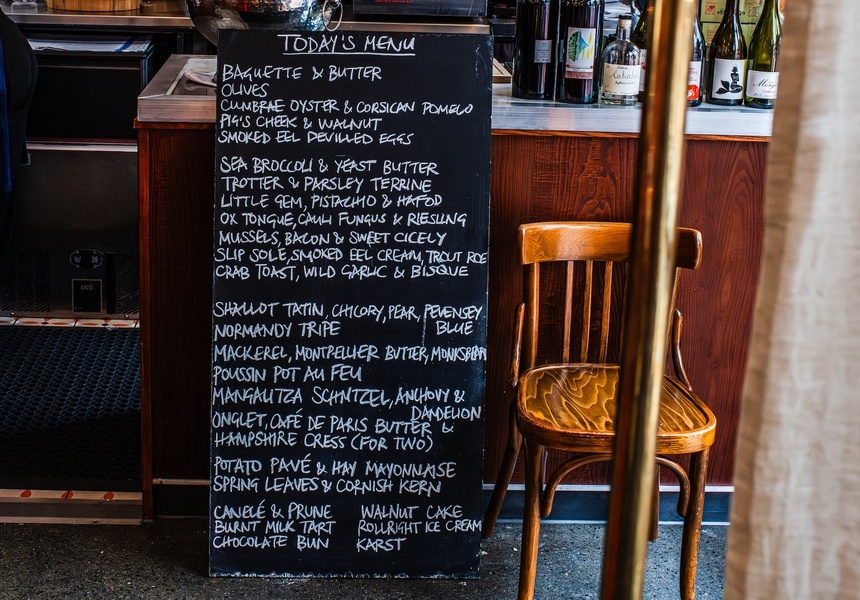
Mark Hix knows this conundrum well. In December, a short clip of the chef speaking on the popular Go To Food Podcast went viral. In it, Hix – long the no-nonsense roisterer of excellent British food – describes his frustration at the contemporary trend for minimalist brevity in menu writing. “Wherever you go now, 99 per cent of places have ‘ingredient-comma-ingredient-comma-ingredient’,” Hix says. “It might say ‘Featherblade, shallots, tarragon, peppercorn’. Is it braised, the featherblade? From a customer’s point of view, you’re second-guessing how things are cooked.”
Hix goes on to describe how, when hosting a dinner at Hugh Fearnley-Whittingstall’s River Cottage recently, he sent the restaurant manager a menu “correctly written” – only to receive it back, a few hours later, with all the “ands” and “withs” taken out. Something crucial was lost, he says. “Is it lazy, or just incompetence?”
“That clip clearly struck a nerve,” he tells me, a few months later. “And it’s quite sweet: a couple of young chefs have actually reached out since and asked if I can read over their menus to check.” His advice to them, and to almost anyone else, is fairly simple: include a few adjectives or descriptors to express specific ingredients, cooking methods or seasonality, and perhaps some adjoining words to express hierarchy or composition.
At The Hart in Marylebone I recently ordered a dish described simply as “steak, potatoes”. It was excellent (I would order an item called “food” from that particular kitchen). But could it have been better still if I’d known that it was a 28-day-aged steak, say, raised in Herefordshire and served with potatoes roasted in duck fat?
The answer, scientifically speaking, is yes. Professor Charles Spence is an experimental psychologist at Oxford University, specialising in how our different sensory experiences interact with one another. Spence was the scientist behind Heston Blumenthal’s iconic Sound of the Sea dish at the Fat Duck, in which seaside sounds were played to diners to make the shellfish taste more shellfishy.
Menu wording, Spence says, can similarly change not just the way we think about a dish, but how it tastes to us too. The menu item “crispy duck salad” is an almost perfect encapsulation of this process, he tells me. The opening “crispy” is appetising but also clarifying; the “duck” in the centre sounds delicious and is clearly the primary ingredient; and the “salad” at the end reassures us that this will not be too heavy or unhealthy. Put in a different order, or with a subtle tweak, and the dish doesn’t work anywhere near as well. “Salad, fried duck”, anyone?
Where does the modern trend for menu minimalism stem from, then? As usual, it can be traced back to St John. When the nose-to-tale temple opened in 1994, with its white walls and no-nonsense aesthetic, it stood as a down-to-earth rebuttal of the fine-dining filigrees of the ’70s and ’80s – vast menus written entirely in French in curlicued scripts, descriptors designed not to enlighten diners but to intimidate them. Set against that finery, a dish of “ox liver, bacon and mash”, which appeared on the restaurant’s first ever menu, seemed beautiful and revolutionary.
“It was almost aggressively English,” says Giles Coren, long-time food critic for the Times. “An antithesis to the wordier Michelin-starred style at places like Le Gavroche,” he says, “where my father would only ever order the things he could pronounce. It’s why everyone got the Dover sole and no one ever ordered the bouillabaisse.”
Jeremy King, the spiritual godfather of the London restaurant scene, agrees that simplicity can be a form of hospitality in itself. “Dishes described in such a way that you don’t know what they are can actually feel antagonistic and arrogant,” he says. “Like interior design, menu writing should never shout for attention – but it should withstand scrutiny. And if all you want is the burger, you shouldn’t have to hear about the cow’s life story to get it.”
But a menu, says Poon’s Amy Poon, is merely an extension of a restaurant’s personality. “They need to be easily understood, but I don’t think simplicity, storytelling and flights of fancy need to be mutually exclusive. I love stories, they’re a way of connecting.” Among the austerely titled favourites at Poon’s Somerset House restaurant – steamed pork, shrimp paste; spring onion, ginger, soy noodles – are a few eye-catching outliers.
“There is a tradition in Chinese culinary culture for giving dishes rather poetic, allegorical names,” says Poon. “The Hill That Amy Didn’t Die On, for example, came about because I really didn’t want prawn toast on the menu but the team – and my mother – argued in its favour. In consulting my father, we found we had a heritage recipe that uses a slice of lardo as a base instead of bread, so I capitulated.
“Not that the practice of naming dishes after a story or person is uniquely Chinese,” she notes, name-checking omelette Arnold Bennett, Kaiserschmarrn, toad-in-the-hole, pavlova and tiramisu.
That kind of narrative-driven cooking finds its zenith, perhaps, in places like Tom Aikens’s restaurant Muse, where every dish is an evocation of the chef’s most formative memories. Like Conquering the Beech Tree, a dish of langoustine, pork fat and burnt apple. In Coren’s opinion this kind of storytelling stems from a core misunderstanding of the nature of cooking. “A chef is a craftsman,” he says. “They perfect a repetitive task. They are not an artist, who does something once and doesn’t do it again. So we do not need to know the chef’s divine inspirations. It’s like a car mechanic. I do not care which tree you climbed as a child – so long as you fix the car.”
Not that a bit of enigma can’t be useful. Dom Hamdy, the restaurateur behind Bistro Freddie, Crispin and Canal, says that esoteric words can sometimes act as useful bridges between diner and restaurant. “We might put ‘tardivo’ on our menu,” he says. “‘It’s this really beautiful, specific radicchio grown in Italy in the dark.” Most diners have probably never heard of it, “so [they] ask what it is, because they know everything else in the dish. And then you’ve got a tiny little spark of interaction, which I think is generally really positive.” On the other hand, one of the best things on the Bistro Freddie menu, I put to him, is a haiku-grade masterpiece of both brevity and evocation: “Chips, mayonnaise”.
“We don’t do ketchup,” he says. “And we could have just put ‘chips’. But something like that – it tells a story in itself.”
This article first appeared in the third issue of Broadsheet London's magazine. Here's where to find a copy.