For a long time, the culinary hallmark of the kind of celebrity-magnet restaurant adored by the fashion set was either healthful and joyless or throwback stodge given a sheen of luxury. Think of the canonical “it” establishments of the past few decades and you will likely think of places where the food graciously demotes itself to being the least important thing in the room. You will think of consolingly soft, haphazardly plated salmon fish cakes at Le Caprice or the Bigham-core shepherd’s pie at The Ivy. You will think of hilariously exorbitant crispy beef and spring rolls amid the dazzling star-wattage of Mr Chow in London, egg-white omelettes at Jean-Georges and idly nibbled sashimi platters at Sexy Fish.
Yes, wonderful aberrations like the River Cafe, which has long balanced critical acclaim with ineffable celebrity appeal, have always existed. But what was once a genre characterised by epicurean ambivalence or faddy asceticism now seems to be increasingly defined by wild, sensual abundance, an egalitarian timelessness of concept and unabashedly exceptional cooking. Bluntly, the past few years have seen the prototypical “fashion restaurant” evolve into something new – something unanimously good and desirable, even to those who do not have security, drivers and an Instagram follower count in the low millions. And I think, as the fashion merry-go-round kicks back into gear, it’s worth looking at why this change might have come about.
It’s probably necessary, first of all, to examine how restaurants would previously be ordained as a favourite among the fashion and entertainment set in the first place. True, there have always been inside jobs – splashy, Mayfair-coded money pits that use favourable deals for celebrity parties and events as a way to brute-force their way to an “it” status that doesn’t always feel fully earned. But the uniting factor across the businesses that have generally filled out this illustrious category is that the restaurant is essentially a synonym for a private nightly soiree hosted by an excessively charming personality. Davé Cheung at Davé in Paris. Jeremy King at The Ivy, Le Caprice, Arlington (and many, many others). Ruthie Rogers at River Cafe. Mourad Mazouz at Sketch and Momo. In the transient, jet-lagged world of runway shows and far-flung filming engagements, these people and places have tended to offer unobtrusive stability and constancy. Frictionless service in art-strewn bunkers. No gawpers or camera phones. Fiercely protective hosts who won’t grass to the papers.
In that sort of environment, experimental or calorifically overbearing cuisine neither works nor is necessary. And it’s an approach that – as evidenced in the sharpened, pace-setting form of recent hospitality-forward successes from the likes of Martin Kuczmarski, Nick Jones and Public House – still has real currency.
Yet, in the 2010s and into the post-Covid era, a new wave of operators, the fade of some creaking, overpriced institutions, and an industry-wide vogue for democratisation took a fair bit of gloss off a format where the entire point was the dangled prospect of seeing someone famous. As a civilian, why would you want to sit in a faded museum exhibit, picking at regressive, cheerfully ruinous food, when you could spy Paul Mescal on a date at Brat, devour Berenjak’s black hummus in the vague orbit of Dua Lipa, or head to Ellie’s in Dalston to emulate Charli xcx while also determining precisely how many £8 Martinis is too many?
Similarly, where those with public profiles could once exclusively frequent velvet-roped spaces and affect disinterest in “fancy” food, now – as proven by the Topjaw or Off Menu interviewees who are clowned in the comments for the boring obviousness of their choices – the move is to display gastronomic knowledge, a common touch and a Bourdainian spirit of rough-and-ready adventurousness.
And that sense of a shift in what is considered cool underpins a lot of this. For all that last year’s industry jitters about GLP-1s were well-founded, my anecdotal read on it is that more and more people in elite restaurants are growing weary of overt Ozempicism or Goopish optimisation culture for the simple reason that it is wearisome and un-chic.
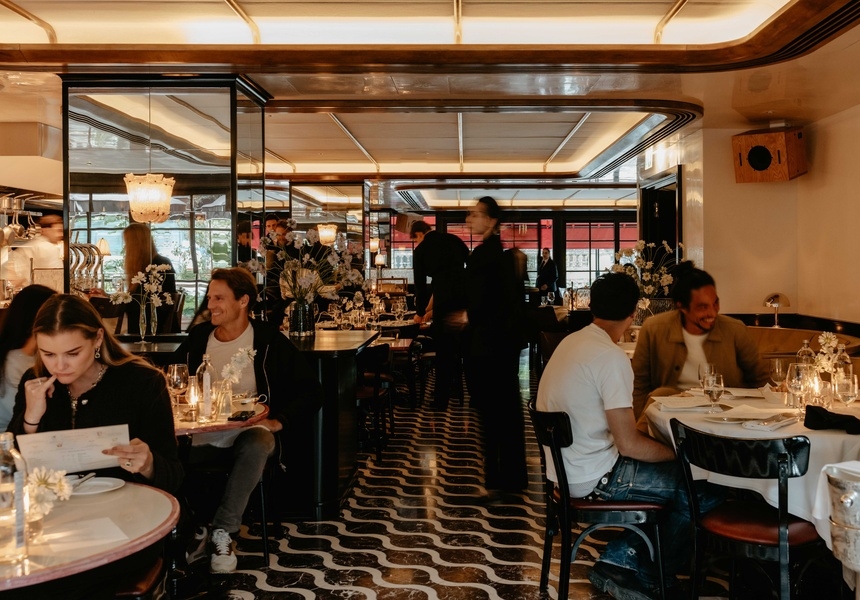
But, however you describe it, it has given us the hubbub generated by Vesper’s off-menu gorgonzola burger, becalmed in its mirrored slick of peppercorn and cognac sauce. And the front-row regulars stampeding towards Dalla to have their weary souls rinsed clean by its buttery tones and peerless brodo. And even the Instagram Stories of trembling, impeccably constructed Devonshire suet puddings that have become their own sort of access flex. (See also: One Club Row and Cece’s. Cafe Clement and Goodbye Horses. Mountain and Dorian.)
These spots have reasserted unbridled pleasure, chef craft and a degree of approachability at the top of hospitality’s hierarchical tree. And they have reminded us, in food and in fashion, that it’s quality that keeps us all coming back.
This article originally appeared in issue 5 of Broadsheet London's print magazine. Find out where you can pick up a copy here.