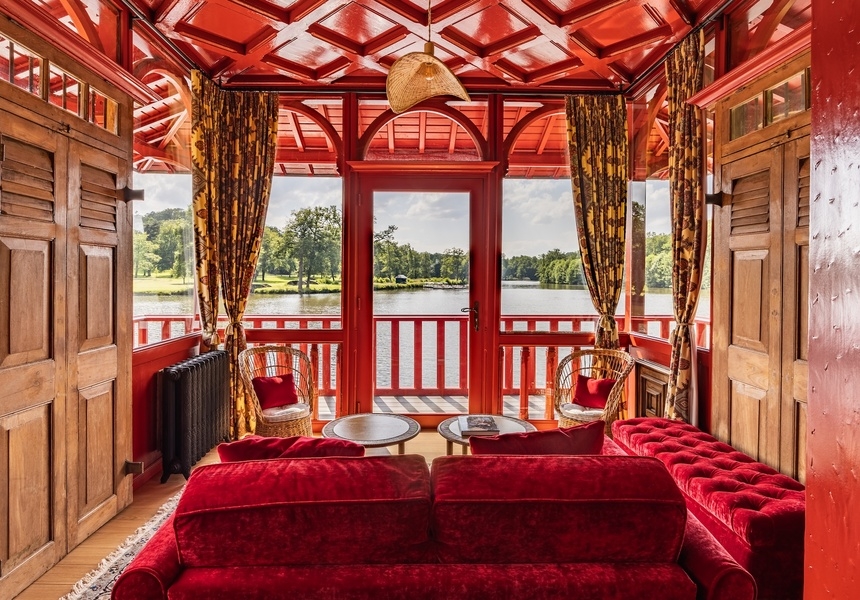
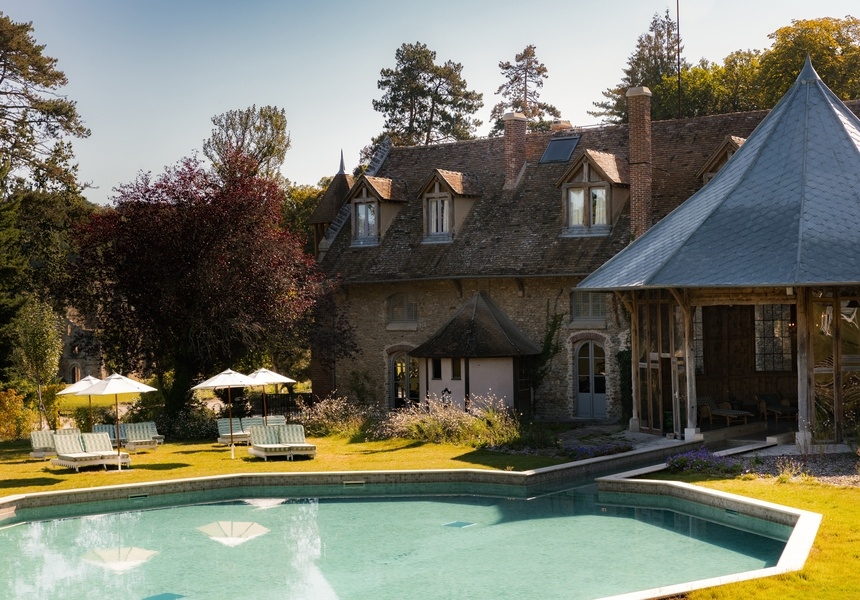
One doesn’t typically look to the sleepy French countryside for moments of show-offy high drama, but Abbaye des Vaux de Cernay might just be the exception. This 12th-century estate, an hour’s glide from Paris, conceals an arcade, a cinema and a karaoke bar within its honey-hued stone exterior. It’s exactly where you’d hope to find yourself on a sun-drenched summer afternoon, three Moëts deep and ready to put that GCSE French to good use by belting Joe le Taxi after a quick paddle on the boating lake. Recently renovated by the Paris Society, the former monastery is full of such surprises (a mountain of pommes frites served on a silver tower being another), though perhaps what’s most surprising is the ease with which Cordélia de Castellane, creative director at Dior Maison, has left her mark on the country pile, which just three years ago sat in a tired state of disrepair.
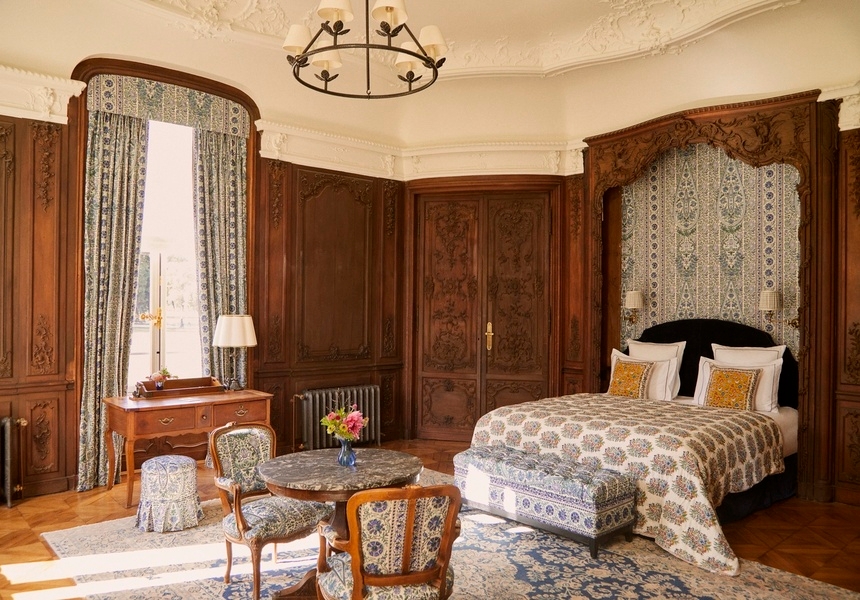
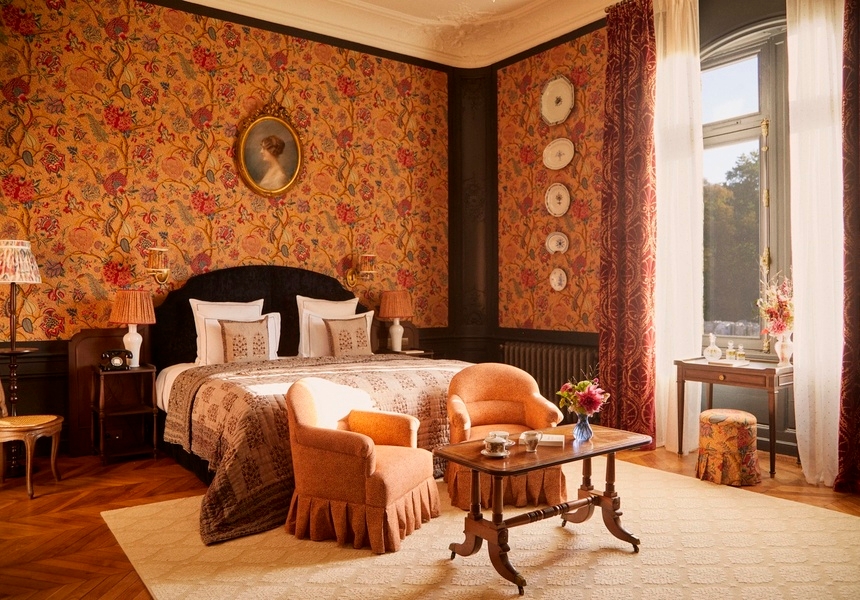
Spanning some 75 hectares, the estate is the stylistic lovechild of Hogwarts and Soho Farmhouse, with ancient features tempered by elaborate textiles wallpaper for a dab of pastoral maximalism. Founded by Cistercian monks in 1118, the abbey’s humble origins were thoroughly overwritten in the 18th century by Baroness Charlotte de Rothschild, who reimagined it as her summer home: a theatre for grand-scale entertaining. Her former bedroom – the Suite de la Baronne – is a Sofia Coppola fever dream, with toile de Jouy fabrics, a bounty of fresh blooms and pretty pastels contrasted against intricately carved oak boiserie.
The Baroness took piano lessons from Chopin, kept company with Balzac, Manet and Henri Rousseau, and enlisted Victor Hugo to design the flower motif that is visible throughout the estate today – cementing Abbaye des Vaux de Cernay as a storied gathering place for the era's most formidable minds. Its rebirth marks another cultural crossover: fashion houses dipping their finely dressed toes into the hospitality pool.
“Fashion and hospitality share a common language. Both are about creating an atmosphere, a sense of emotion and a lasting impression,” de Castellane tells Broadsheet. “At Abbaye des Vaux de Cernay, I approached the interiors much like a silhouette, layering textures, patterns and references.”
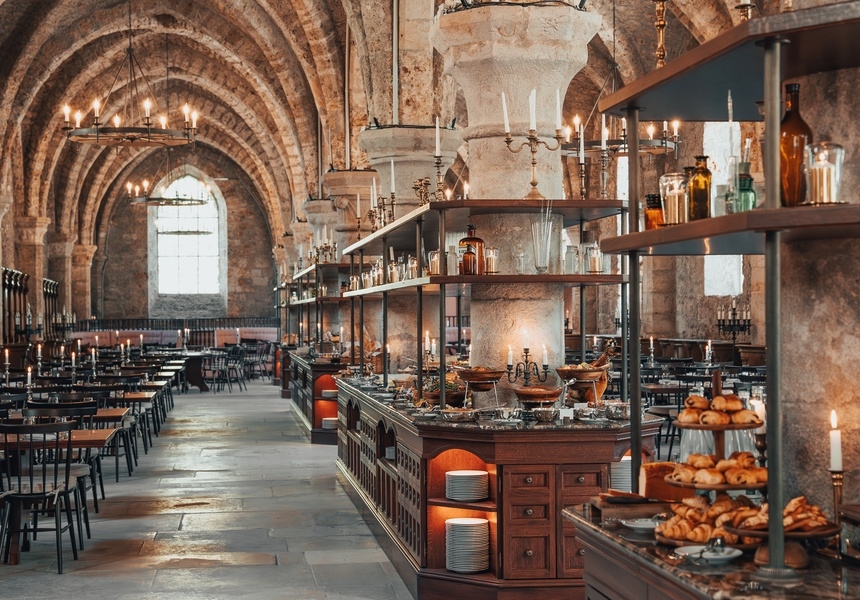
This approach is evident throughout the hotel’s public spaces, where the building’s monastic bones are softened by de Castellane’s baroque sensibilities. Under the vaulted ceilings of the hotel’s James’ Bar, William Morris wallpaper, floral fabrics and unique flea-market finds punctuate thick stone columns and dark wooden panelling. The heritage status (during World War II the surrounding woodlands were used to hide the statues of Versailles; today the abbey is among the most protected sites in France) makes its bedrooms endearingly peculiar – each unique in layout and strictly devoid of air conditioning to preserve the medieval stone.
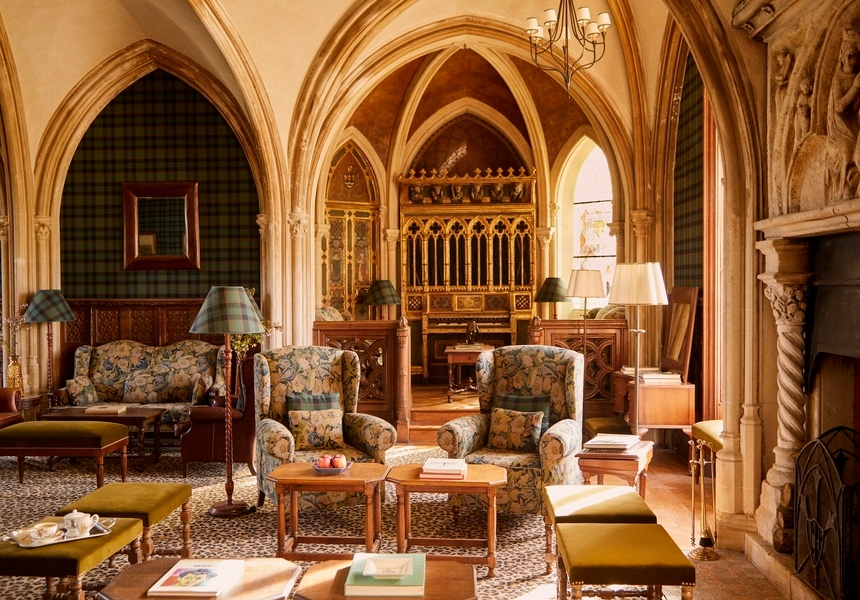
In the English manor-inspired lounge, oversized tartan and flashes of leopard print sit confidently beside a gold-gilded oratory, which still houses the abbey’s original organ. This time-travelling alchemy makes the cavernous estate feel lived-in and intimate, as if these rooms hadn’t really been designed at all.
That sense of nonchalance is summoned in no small part thanks to the litany of artisans de Castellane rallied for the project – Bernardaud for porcelain, Maison Pierre Frey for fabrics, Maison Laval for the joinery. “It’s about attention to detail, a certain refinement, and an intuitive sense of balance,” she says. “I like spaces to feel composed but never rigid, elegant but always welcoming – places where you immediately feel at ease, yet where every element has been thoughtfully chosen.”
abbayedesvauxdecernay.com
Four More Fashion-House Hotels
Rhinoceros Roma, Rome, Italy
“The important thing in life is never to do anything banal,” fashion heiress Alda Fendi told Sotheby’s six months after the launch of Rhinoceros Roma. True to her word, her collection of apartment-style stays in a 17th-century palazzo is anything but ordinary. Maverick architect Jean Nouvel has masterfully spliced the building’s graffiti-etched history with sharp slabs of stainless steel, bright statement furniture and runway-worthy lighting. It’s high-concept and unapologetically bold, much like the work in the gallery spaces downstairs.
rhinocerosroma.com
Vermelho Melides, Alentejo, Portugal
Christian Louboutin’s first foray into hospitality invites guests to kick off their red soles and slip into something a little more comfortable. Tucked away in a sleepy Alentejo village, every detail of this 13-room, adults-only stay – from handpainted murals to golden velvet upholstery – has been purposely crafted by Louboutin’s inner circle. With treasures selected from his personal Parisian archives and a chic, silver-clad bar, it has all the soul of a fabulously eccentric family home.
vermelhohotel.com
Portrait Milano, Milan, Italy
In Italy’s fashion capital, Portrait Milano serves as a high-spec tribute to Salvatore Ferragamo, the legendary shoemaker to the stars. Fittingly placed along the label-laden Corso Venezia and once a 16th-century seminary, this Lombard baroque landmark was reimagined by architect Michele Bönan for the Ferragamo family. He’s injected a healthy dose of high-fashion drama into the rooms and suites, artfully layering dark woods, white marble and jewel-toned rugs.
lungarnocollection.com/portrait-milano-hotel
Domaine de la Cavalerie, Provence, France
Once the grand summer residence of French designer Emanuel Ungaro, this fairytale estate in the lavender-scented Luberon region is marking its first summer as a fully serviced private retreat. La Cavalerie was where Ungaro came to slow down after the frenzy of fashion week. Here, he traded runways for tending the land and filling rooms with a lifetime of treasures. Spread across 160 acres, the estate’s focus remains on slow living and connection – long lunches and lazy afternoons spent with those who matter.
domainedelacavalerie.com